

Learning mooring system
Author:China Shipping Anchor Chain(Jiangsu) Co.,Ltd
Click:
Time:2021-08-21 00:00:00
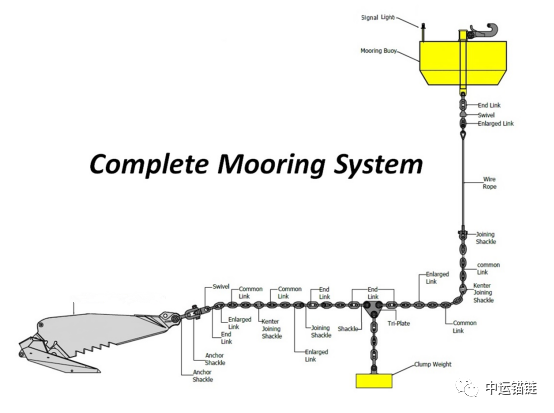
Mooring system refers to the use of cables to secure the ship to the wharf or other places to limit its movement. In addition, floating structures (such as drilling vessels, semi submersibles, pipelay barges, etc.) are connected to fixed points on the seabed and their movement is limited.
1.Multi buoy mooring system (MBM), a traditional buoy mooring system – a facility through which the ship is usually moored by a combination of anchor and stern mooring buoy and fixed in a fixed heading. Also known as conventional buoy mooring.
2.
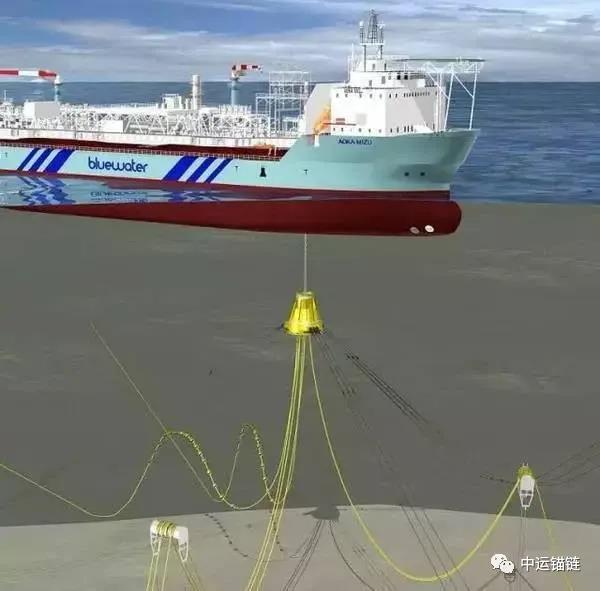
Single point mooring (SPM), a facility that secures the ship to a single buoy or structure through the bow and swings freely with the prevailing wind and ocean currents. Three types of single point mooring systems are commonly used: catenary anchor leg mooring, single anchor leg mooring and turret mooring.
Single point mooring (SPM) is a floating buoy / wharf, which is anchored at sea and allows the loading and unloading of liquid goods, such as petroleum products of ships. SPM is mainly used in areas without special liquid cargo handling facilities. These single point mooring (SPM) facilities are several kilometers away from coastal facilities and are connected by submarine and submarine oil pipelines. They can even handle super large capacity ships, such as VLCC.
Single point mooring (SPM) serves as the connection between onshore facilities and ships for loading or unloading liquid and gas cargo.
Some of the main benefits of using SPM are:
*Dealing with very large ships.
*There is no need for ships to arrive at the port, thus saving fuel and time.
*Ships with high draft can be easily moored.
*High quality goods are easy to handle.
你的喜欢,就是我坚持写下去的能量器
YouArticle
已有2人推荐
China Shipping Anchor Chain@ 2020 website map

点击右上角
分享给朋友吧